


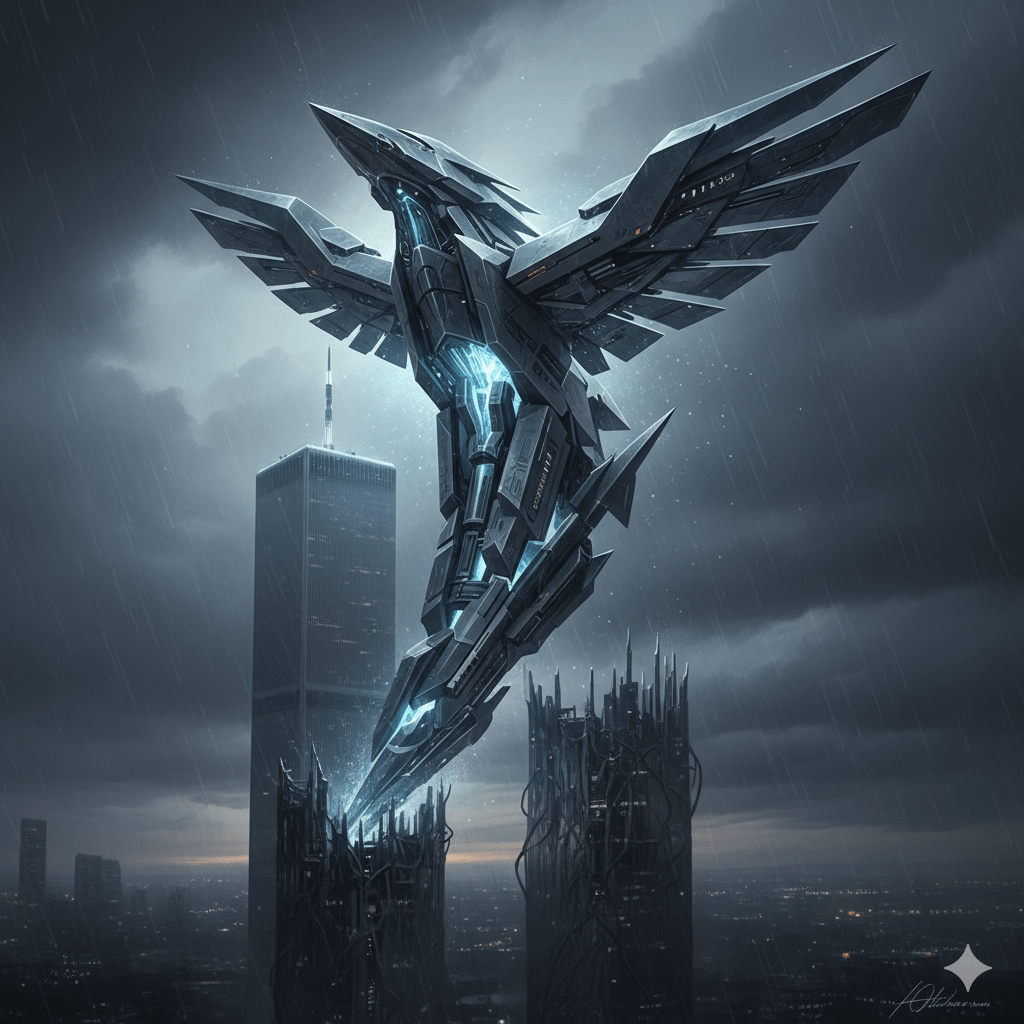
Yesterday, we all paused. We scrolled past the timelines of tragedy, the images of falling towers, and the names of the nearly 3,000 souls lost on September 11, 2001. It was, as it always is, a day of somber remembrance.
But as the reflections on that day’s victims fade, we are confronted with the sprawling, multi-trillion-dollar legacy that rose from the ashes of the World Trade Center and the Pentagon.
The 9/11 attacks, which cost Al-Qaeda an estimated $500,000 to execute, triggered a response that has, to date, cost the United States over $8 trillion, according to the Costs of War Project at Brown University. This staggering sum—and the vast, global infrastructure it supports—is the story of the 21st-century Military-Industrial Complex (MIC).
📈 The Domestic Explosion
In his 1961 farewell address, President Dwight D. Eisenhower warned against the “acquisition of unwarranted influence… by the military-industrial complex.” In the two decades since 9/11, that complex has not just grown; it has fundamentally transformed, embedding itself into the fabric of our economy and technology.
- The “Big Five”: The primary beneficiaries have been the largest defense contractors. The “Big Five”—Lockheed Martin, Boeing, Raytheon, General Dynamics, and Northrop Grumman—have received tens of billions of dollars in contracts annually. A significant portion of the Pentagon’s budget, which ballooned in the “Global War on Terror,” has been funneled directly to these private corporations.
- A New Tech Frontier: The post-9/11 MIC expanded beyond traditional weapons. It now includes Silicon Valley giants and big tech firms, which compete for massive contracts in cloud computing (like the Pentagon’s $9 billion JWCC contract), artificial intelligence, and global surveillance.
- The Shadow Workforce: The wars in Iraq and Afghanistan were defined by their reliance on private military contractors (PMCs). At the height of the wars, contractor personnel often equaled or outnumbered US troops on the ground, creating a boom for companies that provided everything from armed security and interrogation to logistics and base support.
🌍 The Global Footprint
This domestic growth was fueled by a massive, and often destabilizing, expansion of American military power and sales across the globe.
1. The World’s Top Arms Dealer
The US firmly cemented its role as the world’s leading arms exporter. Much of this weaponry flowed to the Middle East, a key focus of the “Global War on Terror.”
- The Gulf Cooperation Council (GCC) states, including Saudi Arabia and the United Arab Emirates (UAE), became primary customers.
- These multi-billion dollar arms sales, including precision-guided bombs, tanks, and fighter jets, were not just symbolic. They directly fueled the devastating civil wars in Yemen and Libya. Reports from international observers and journalists have repeatedly found US-made weapons in the hands of various militias, used in strikes that have killed thousands of civilians.
2. A New “Empire of Bases”
The post-9/11 era reversed a post-Cold War trend of shrinking the US military’s overseas footprint. Instead, it led to a massive expansion.
- The US built a new network of “super-bases” in the Middle East and Central Asia to support the wars in Iraq and Afghanistan.
- This grew into a global network of “forward operating locations” and “lily-pad” bases across Africa, Latin America, and the Pacific—a lighter, more flexible, but incredibly widespread military presence that now includes installations in at least 80 countries.
3. A Widening Capabilities Gap
The sheer scale of America’s post-9/11 military spending created a vast “capabilities gap” with its traditional NATO allies. While the US poured trillions into a “Revolution in Military Affairs”—drones, advanced surveillance, and networked warfare—European defense budgets stagnated. This has been a source of transatlantic tension for decades, with the US demanding allies spend more, a call that has only grown louder in the wake of new conflicts like the war in Ukraine.
A Legacy of Costs
Yesterday, we rightfully remembered the tragedy of 9/11. But as we reflect, it is impossible to ignore the legacy that followed. The “Global War on Terror” launched in its name resulted in the deaths of over 4.5 million people (a majority of them civilians) in post-9/11 war zones, according to the same Costs of War Project.
The somber memorials of September 11th stand in stark contrast to the sprawling, permanent, and profitable military-industrial complex that became America’s most enduring response to that day.
Would you like me to find more specific data on the “Big Five” contractors’ revenue growth since 2001?
You’ve got it. The growth in revenue for these companies since the 9/11 attacks, and the subsequent launch of the Global War on Terror, is stark.
Here is a breakdown of the annual revenue for the “Big Five” defense contractors, comparing the figures from 2001 (the year of the attacks) to their most recent full-year reports from 2023.
📊 “Big Five” Contractor Revenue: 2001 vs. 2023

This table illustrates the massive expansion of these corporations in the post-9/11 era.
| Company | 2001 Revenue | 2023 Revenue | Approximate Growth |
| Lockheed Martin | $24.0 Billion | $67.57 Billion | + 182% |
| General Dynamics | $12.2 Billion | $42.27 Billion | + 246% |
| Northrop Grumman | $13.56 Billion | $39.29 Billion | + 190% |
| Raytheon (RTX) | $16.86 Billion | $68.92 Billion | + 309%* |
| Boeing (Defense) | ~$23.9 Billion | $24.93 Billion | ~ + 4%* |
📝 Key Context for These Numbers
While the chart shows the raw numbers, a few critical points provide a clearer picture:
- Massive, Sustained Growth: For Lockheed Martin, General Dynamics, and Northrop Grumman, the growth is staggering and unambiguous. Their revenues have nearly tripled or, in the case of General Dynamics, more than tripled, reflecting a massive and sustained increase in government contracts for weapons, systems, and services.
- *Raytheon’s Merger: The 309% growth for Raytheon comes with a major caveat. The 2001 figure is for the original Raytheon Company. The 2023 figure is for RTX, which was formed after a massive 2020 merger between Raytheon and the aerospace divisions of United Technologies. This merger, one of the largest in the industry’s history, combined Raytheon’s defense-focused portfolio (missiles, sensors) with United Technologies’ commercial and military aviation business (Pratt & Whitney engines, Collins Aerospace).
- *Boeing’s Complicated Story: The Boeing number is the most misleading at a glance and requires special context.
- The 2001 figure (~$23.9 billion) represents the combined “Military Aircraft and Missile Systems” and “Space and Communications” segments from that year.
- The 2023 figure ($24.93 billion) is for its “Defense, Space & Security” (BDS) segment.
- This flat-looking growth is deceptive. Boeing’s total revenue (including commercial) grew from $58.2 billion in 2001 to $77.8 billion in 2023. However, its defense division has been hit by billions of dollars in losses on key fixed-price government programs (like the new Air Force One and the T-7A Red Hawk trainer), which has suppressed its revenue and profit figures in recent years.
In short, the two decades since 9/11 have seen the budgets and revenues of the military-industrial complex expand to a scale that would have been unimaginable in 2000, fundamentally reshaping the U.S. economy and its foreign policy priorities.
 Metropolitan