


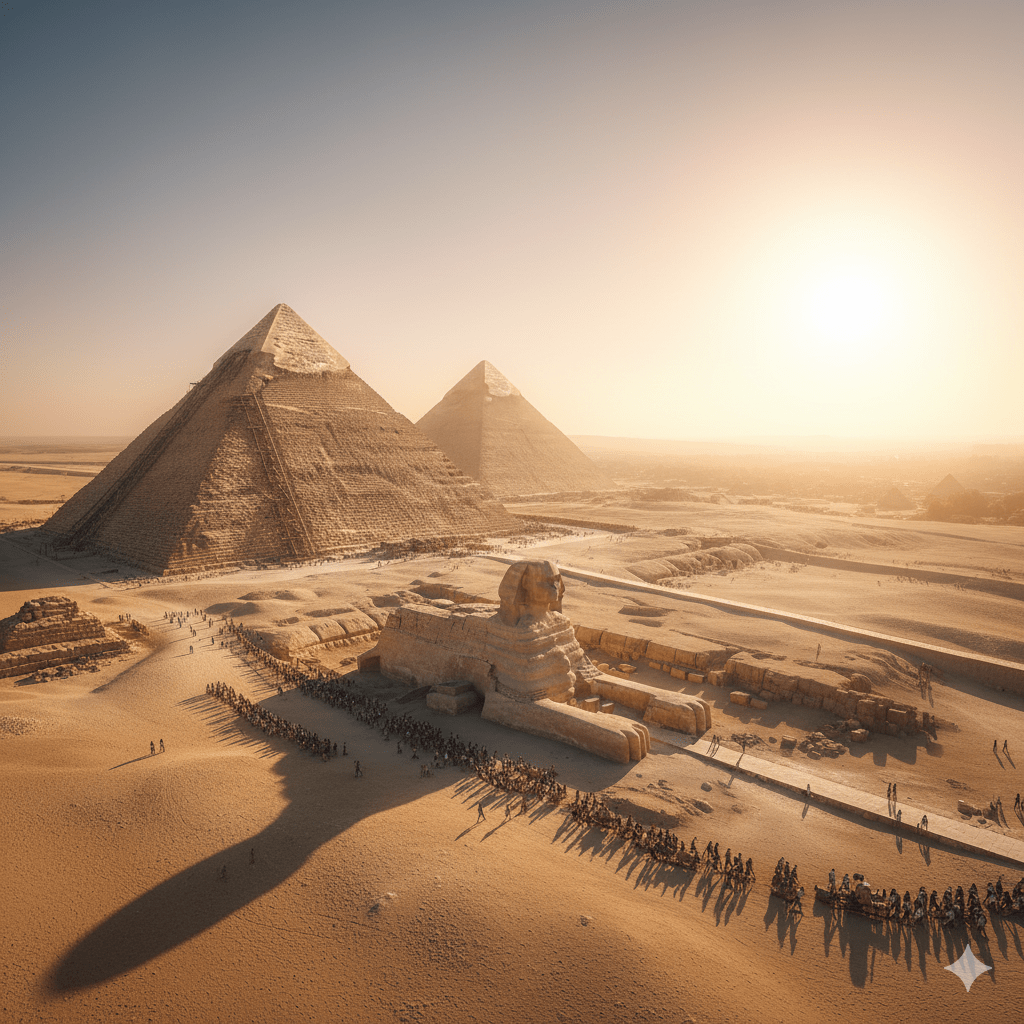
Picture it: a triangular shadow stretching long across the desert floor as the sun dips below the horizon. The air is still, and standing before you is a mountain of stone, so perfect in its geometry, so massive in its scale, that it seems to challenge the very laws of time and physics.
This is the timeless power of the Egyptian Pyramids.
For over 4,500 years, these monuments have been the planet’s most enduring riddle. They are the last of the Seven Wonders of the Ancient World still standing, a silent, stone testament to a civilization that believed in eternity and had the audacity to build it.
We’ve all seen the pictures, but to truly explore the pyramids is to ask the two great questions that have fascinated historians, engineers, and dreamers for millennia: How did they do it? And why?
🏛️ The Titans of Giza: More Than Just Tombs
When we think of pyramids, we think of Giza. The three main structures—the Great Pyramid of Khufu, the Pyramid of Khafre, and the Pyramid of Menkaure—dominate the plateau, watched over by their enigmatic guardian, the Great Sphinx.
Let’s just talk scale. The Great Pyramid of Khufu is a mathematical marvel.
- It’s built from 2.3 million stone blocks, some weighing as much as 80 tons.
- For over 3,800 years, it remained the tallest man-made structure on Earth.
- Its four sides are aligned almost perfectly with the four cardinal points of the compass.
And the marvel you see today is just the core. Originally, these pyramids were encased in highly polished white casing stones. In the bright Egyptian sun, they would have gleamed with a brilliant, blinding light—colossal jewels in the desert, reflecting the sun’s rays.
💡 The Great Enigma: A Feat of Human Genius, Not Aliens
So, how was this possible in an age without cranes or modern machinery?
Forget the wild theories of aliens or lost technologies. The truth, as archaeologists are piecing it together, is far more impressive. The construction of the pyramids was not a miracle; it was a triumph of human logistics, mathematics, and sheer willpower.
Myth-busting: The pyramids were not built by slaves. Archaeological finds, including worker villages and cemeteries, show they were built by a massive, skilled, and well-fed (and paid) workforce of Egyptian laborers. These were loyal subjects, building a ladder to the heavens for their god-king.
To move the massive blocks, it’s believed they used:
- Enormous sledges dragged over sand, which was likely wetted to reduce friction.
- Ingenious ramp systems—either one long, straight ramp or a spiral ramp corkscrewing around the pyramid—to haul the blocks to staggering heights.
- Flawless surveying. They likely found “true north” by observing the stars and created a perfectly level base, possibly by flooding the excavated foundation with water and leveling it to the waterline.
The real secret of the pyramids isn’t a lost technology; it’s a lost level of collective focus and organizational genius.
✨ The ‘Why’: A Resurrection Machine for a God
But why go to all this trouble? The purpose of the pyramids was one of the most profound in human history: they were not just tombs; they were “resurrection machines.”
The pharaoh was considered a god on Earth, and the pyramid was his vehicle for the afterlife.
- A Ladder to the Stars: The shape itself was a “stairway to heaven.” The solid, sloping sides were seen as a physical ramp for the pharaoh’s soul, or ka, to ascend and join the gods.
- Rays of the Sun: The pyramid’s form also mimicked the benben, a sacred stone that represented the primordial mound from which the god Atum created the world. The sloping sides were seen as the solidified rays of the sun god, Ra, connecting the pharaoh to the divine.
- An Eternal Home: The pyramid was a fortress designed to protect the pharaoh’s mummified body for eternity. Ancient Egyptians believed the ka needed a physical body to return to. Inside, passages led to burial chambers, and walls were covered in “Pyramid Texts”—magic spells and incantations, the oldest known religious texts in the world, ensuring the pharaoh’s safe passage through the underworld.
🌎 Echoes of an Idea: Are All Pyramids Related?
The pyramid is a powerful, primal shape, and it’s no surprise it appeared in other cultures. But were they connected?
The Heirs: The Nubian Pyramids
Yes. To the south of Egypt, in modern-day Sudan, the kings of the Kushite kingdom built their own pyramids. These Nubian pyramids at Meroë are a direct echo of the Egyptian tradition, as Kushite kings once conquered and ruled Egypt as pharaohs.
- Relativity: They were directly inspired by Egyptian pyramids but built over 1,500 years later.
- The Difference: They are far more numerous (over 250 of them), but also much smaller, steeper, and built over the burial chamber rather than housing it within.
The Coincidence: The Mesoamerican Pyramids
No. Across the Atlantic, thousands of years later, civilizations like the Maya and Aztecs built their own magnificent pyramids, like the Pyramid of the Sun at Teotihuacan or the temples at Chichen Itza.
- Relativity: There is no connection. This is a case of “convergent evolution”—two different cultures independently arriving at the same engineering solution. Why? Because a pyramid is the most stable shape for building a very tall structure.
- The Difference: The purpose was entirely different. The Egyptian pyramid was a sealed, private tomb. The Mesoamerican pyramid was a public temple—a flat-topped stage with grand staircases for priests to climb and perform rituals in front of the gathered populace.
The Sands of Time
Today, the Egyptian Pyramids still hold their secrets. In 2017, scientists using advanced scanning technology discovered a massive, hidden “void” within the Great Pyramid, its purpose completely unknown.
To stand at their base is to feel a profound connection to the past. They are a challenge to our modern perspective, a reminder that 4,500 years ago, a civilization driven by a powerful belief system achieved the impossible. They didn’t just build a monument; they built eternity. And against all odds, they nearly achieved it.
 Metropolitan