



The Knights Templar, also known as the Order of the Poor Knights of Christ and the Temple of Solomon, was a medieval Christian military order that rose to prominence during the Crusades in the 12th century. Established around 1119, the Templars played a significant role in the religious, military, and political landscapes of the Middle Ages, eventually becoming one of the most powerful and influential institutions of their time.
Origins and Formation
The Knights Templar were founded by a group of knights, led by Hugues de Payens, in the aftermath of the First Crusade (1096–1099). The order’s original mission was to protect Christian pilgrims traveling to the Holy Land, specifically to Jerusalem, which had been captured by Crusaders. The name “Templar” derives from the order’s headquarters, located near the Temple of Solomon in Jerusalem, which was believed to be a site of great religious significance.
Pope Honorius II officially recognized the Knights Templar in 1129, and they were granted a rule and a charter, allowing them to establish their own military and financial operations. The order was sanctioned by the Catholic Church, which provided them with legitimacy and protection.
Military Role in the Crusades
The Knights Templar gained widespread fame for their military prowess during the Crusades, a series of religious wars fought between Christians and Muslims for control of the Holy Land. As professional soldiers, the Templars participated in several key battles, defending Christian territories against Muslim forces. The Templars were particularly known for their skill in mounted combat and their unwavering discipline.
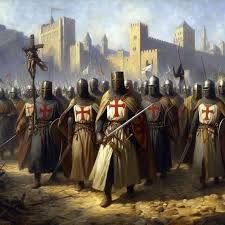
Their military success earned them both wealth and influence, allowing them to expand their operations throughout Europe and the Holy Land. They established a network of castles, forts, and estates across the region, which not only served as military outposts but also provided the order with substantial resources to fund their operations.
Financial Power and Banking
One of the unique aspects of the Knights Templar was their role as early financiers. Over time, the order became a powerful banking institution, with members entrusted to safeguard pilgrims’ valuables and act as moneylenders. They developed an extensive financial network across Europe, with Templar properties and resources spanning multiple kingdoms and regions.
The Templars are often credited with pioneering several banking techniques, including the use of letters of credit, which allowed pilgrims to deposit money in one location and withdraw it in another. This system greatly enhanced their financial reach and facilitated the flow of wealth across Christendom. By the early 14th century, the Templars had amassed considerable wealth, which made them both influential and vulnerable.
Decline and Suppression
Despite their military success and financial power, the Knights Templar faced growing suspicion and hostility from various quarters. In the early 14th century, King Philip IV of France, deeply indebted to the Templars, sought to eliminate the order and seize their wealth. In 1307, he orchestrated a dramatic crackdown on the Templars, accusing them of heresy, blasphemy, and immoral conduct. The knights were arrested, tortured into confessions, and many were executed. The Grand Master of the Templars, Jacques de Molay, was burned at the stake in 1314.
In response to Philip IV’s actions, Pope Clement V, under political pressure, formally disbanded the Knights Templar in 1312. The order’s wealth and properties were seized by the French crown, and many of the surviving members were either executed or forced into hiding. However, despite the official disbandment, rumors and myths surrounding the Templars persisted.
Legacy and Myths
The Knights Templar left behind a complex legacy. While the order was officially dissolved, its name and image have lived on through various myths, legends, and conspiracy theories. The Templars were often associated with secret knowledge, and they have been the subject of numerous works of fiction and speculation, including popular books like The Da Vinci Code by Dan Brown.
Historically, the Templars contributed significantly to the development of medieval chivalry, military tactics, and banking systems. Their emblem, a red cross on a white mantle, has become an enduring symbol of the order’s influence.
Conclusion
The Knights Templar were more than just warriors; they were pioneers in banking, military strategy, and religious devotion. Despite their tragic end in the early 14th century, the Templars’ legacy continues to capture the imagination of people around the world. The blend of fact and myth surrounding their history ensures that the story of the Knights Templar remains one of the most fascinating chapters of medieval history.
 Metropolitan