


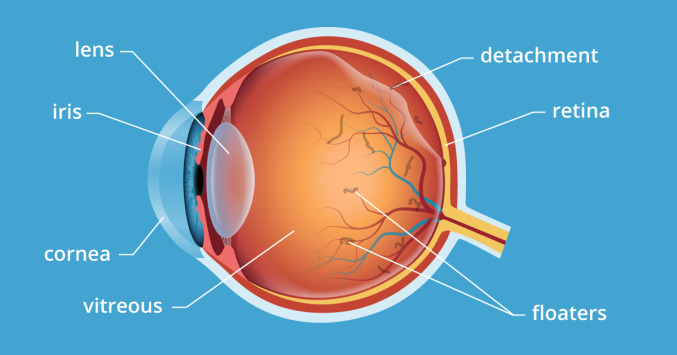
Although this name may sound like a cool gadget that you probably wear around your eyes, let me be the first to inform you that it’s not.Eye floaters is a rare eye condition that affects quite a small number of people.Those with such a condition tend to see small blocks or chains of well-intertwined shapes that to the normal eye are totally invisible.
At first, persons with the condition may be mistaken for hallucinations or being possessed by a demon only that the images are constant and do no known harm.
The condition is mostly observed in the elderly but may affect the younger generation.It comes as a result of the retina being torn over the years
Eye floaters are spots in your vision. They may look to you like black or gray specks, strings, or cobwebs that drift about when you move your eyes and appear to dart away when you try to look at them directly.
Most eye floaters are caused by age-related changes that occur as the jelly-like substance (vitreous) inside your eyes becomes more liquid. Microscopic fibers within the vitreous tend to clump and can cast tiny shadows on your retina. The shadows you see are called floaters.
If you notice a sudden increase in eye floaters, contact an eye specialist immediately — especially if you also see light flashes or lose your peripheral vision. These can be symptoms of an emergency that requires prompt attention.
Symptoms
- Small shapes in your vision that appear as dark specks or knobby, transparent strings of floating material
- Spots that move when you move your eyes, so when you try to look at them, they move quickly out of your visual field
- Spots that are most noticeable when you look at a plain bright background, such as a blue sky or a white wall
- Small shapes or strings that eventually settle down and drift out of the line of vision
When to see a doctor
Contact an eye specialist immediately if you notice:
- Many more eye floaters than usual
- A sudden onset of new floaters
- Flashes of light in the same eye as the floaters
- Darkness on any side or sides of your vision (peripheral vision loss)
These painless symptoms could be caused by a retinal tear, with or without a retinal detachment — a sight-threatening condition that requires immediate attention
Other research has shown that up to 50 percent of people with a retinal tear will subsequently develop a detachment of the retina, which could lead to significant vision loss.
In cases of retinal tear or detachment, treatment must occur as soon as possible so that an eye surgeon can reattach the retina and restore function before vision is lost permanently.
Posterior vitreous detachments (PVDs) are far more common than retinal detachments and often are not an emergency even when floaters appear suddenly. Some vitreous detachments also can damage the retina by tugging on it, leading to a tear or detachment.
 Metropolitan