


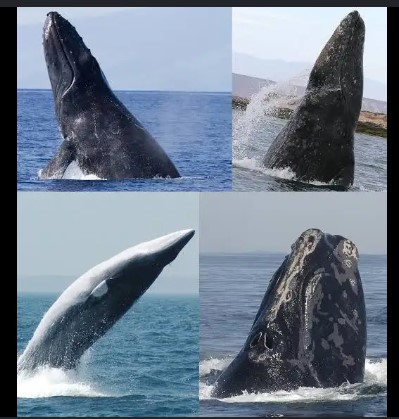
The ocean hides some of the planet’s most fascinating secrets, but none are as breathtaking as cetaceans—whales. These marine mammals are engineering marvels of the natural world, possessing unique physical traits and embarking on epic seasonal journeys across the globe.
To understand these magnificent creatures, scientists divide them into two primary categories based on how they eat: Baleen whales (Mysticeti) and Toothed whales (Odontoceti).
1. Baleen Whales (Mysticeti): The Filter Feeders
Baleen whales do not have teeth. Instead, they sport rows of fingernail-like baleen plates made of keratin. They use these plates like a massive strainer to trap thousands of pounds of tiny krill and small fish from the water every day.
The Blue Whale (Balaenoptera musculus)
- Distinct Characteristics: The largest animal ever known to live on Earth. A blue whale can grow up to 100 feet long and weigh as much as 200 tons. Their tongues alone can weigh as much as an elephant, and their hearts are the size of a small car.
- Movement & Migration: Despite their colossal size, they are sleek swimmers, comfortably cruising at 5 to 12 mph, but capable of hitting bursts of 20 mph. They undertake massive seasonal migrations, traveling from icy polar feeding grounds in the summer to warm equatorial breeding lagoons in the winter.
The Humpback Whale (Megaptera novaeangliae)
- Distinct Characteristics: Famous for their exceptionally long pectoral fins (up to one-third of their body length) and the haunting, complex “songs” males sing for hours at a time.
- Movement & Migration: Humpbacks are the acrobats of the ocean. They frequently breach (leap entirely out of the water) and slap the surface with their fins. They are also known for bubble-net feeding, a highly coordinated behavior where a pod swims in a shrinking circle while blowing bubbles underwater to trap schools of fish like a net before lunging upward with open mouths.
2. Toothed Whales (Odontoceti): The Ocean Hunters
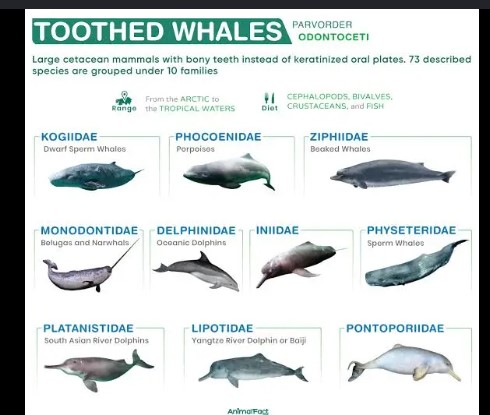
Unlike their filter-feeding cousins, toothed whales possess actual teeth and actively hunt individual prey—ranging from fish and squid to seals and even other whales. They rely heavily on echolocation (using sound echoes to navigate and hunt in pitch-black waters).
The Sperm Whale (Physeter macrocephalus)
- Distinct Characteristics: Recognizable by their massive, block-shaped heads, which house a cavity filled with a high-quality oil called spermaceti. They have the largest brain of any creature in evolutionary history.
- Movement & Migration: Sperm whales are the champion deep-divers of the mammalian world. They routinely plunge down to 3,280 feet—and occasionally past 6,000 feet—holding their breath for over an hour to battle giant squid in the abyssal depths. Their migrations are less rigid than baleen whales; adult males wander into colder polar waters while females and juveniles stick to warmer, tropical regions year-round.
The Orca / Killer Whale (Orcinus orca)
- Distinct Characteristics: Easily identified by their striking black-and-white patterns and tall, triangular dorsal fins. Though commonly called whales, orcas are actually the largest members of the oceanic dolphin family.
- Movement & Migration: Orcas are apex predators and incredibly fast, hit speeds of 30+ mph. Instead of following a strict north-south migration map, their movements are nomadic and dictated entirely by local food availability. A pod might patrol a specific coastline for weeks tracking salmon runs, then vanish into the open ocean to hunt migrating seals.
At-A-Glance: Comparing the Icons of the Ocean
| Whale Type | Suborder | Max Length | Primary Diet | Standout Behavior |
| Blue Whale | Baleen | 100 feet | Krill | Long-distance solo navigation |
| Humpback | Baleen | 52 feet | Small fish / Krill | Acrobatic breaching & singing |
| Sperm Whale | Toothed | 60 feet | Deep-sea squid | Extreme deep-sea diving |
| Orca | Toothed | 32 feet | Fish, seals, sharks | Apex tactical pod hunting |
Did You Know? Whales are vital to our atmosphere. Through a phenomenon known as the “whale pump,” their vertical movement brings nutrients from the deep sea to the surface, feeding phytoplankton. These tiny organisms pull tons of carbon dioxide out of our air and produce over 50% of the world’s oxygen supply!
 Metropolitan