


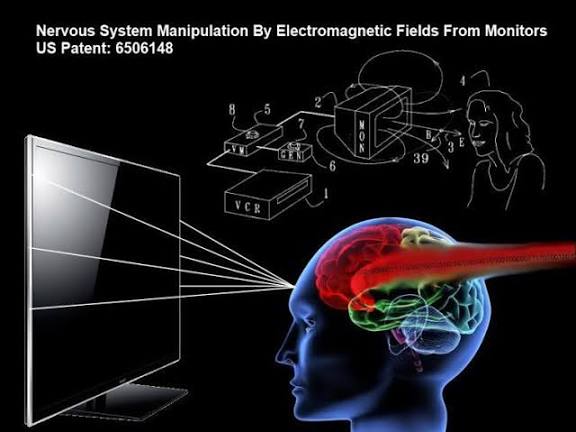
Have you ever felt a sudden wave of drowsiness while scrolling through your computer? Or perhaps a strange, unexplainable sense of unease while watching a late-night TV show? While we usually blame blue light or “doomscrolling,” a fascinating and chilling legal document suggests there might be something far more technical happening behind the glass.
Welcome to the rabbit hole of US Patent 6506148 B2: Nervous System Manipulation by Electromagnetic Fields from Monitors.
What exactly is US Patent 6506148 B2?
Filed in 2001 by a mysterious inventor named Hendricus G. Loos, this patent outlines a method to manipulate the human nervous system using the electromagnetic fields (EMFs) emitted by everyday monitors.
The core of the theory is “sensory resonance.” According to the patent, the human nervous system can be “tuned” like a radio. By pulsing the images on a screen at very specific low frequencies—specifically around 1/2 Hz or 2.4 Hz—a monitor can trigger physiological responses in a person sitting nearby.
The “Symptom List” of a Pulsed Brain
The patent doesn’t just claim to make you blink; it lists a startling array of physiological effects observed during experiments with these weak electromagnetic pulses:
- Ptosis (Drooping) of the eyelids
- Sudden relaxation or drowsiness
- A “tonic smile” (an involuntary grin)
- A feeling of pressure on the brow
- Sexual excitement
- Sudden loose stool
The most unsettling part? The patent states these effects can be achieved even if the image pulsing is subliminal—meaning you can’t consciously see the flickering, but your nervous system feels it.
Science or Science Fiction?
On paper, the science is grounded in biology. Our nerves communicate via electrical impulses. Transcranial Magnetic Stimulation (TMS) is a real medical procedure used today to treat depression by using magnets to stimulate brain cells.
However, Patent 6506148 B2 takes this a step further by claiming that the unintentional fields from a standard TV or computer monitor are strong enough to do this remotely. While the scientific community remains skeptical about whether a standard consumer monitor has enough power to “control” a human, the mere existence of the patent in the USPTO archives is enough to fuel endless debate.
Who is Hendricus G. Loos?
The mystery deepens when you look for the inventor. Hendricus G. Loos has filed over a dozen patents related to remote nervous system manipulation, including “Remote Magnetic Manipulation of Nervous Systems” and “Pulsative Manipulation of Nervous Systems.” Despite his prolific patent history, Loos is a ghost—no university ties, no public photos, and no corporate office. This has led many to speculate whether “Loos” was a pseudonym for a government research project or a private defense contractor.
Why This Matters Today
In an age where we spend 7–10 hours a day in front of screens, the idea that our devices could be influencing our moods or biological states without our knowledge is a modern-day digital ghost story.
Whether this technology is actively being used in “program material” (as the patent suggests) or is simply a theoretical discovery that never left the lab, it serves as a powerful reminder: The bridge between our biology and our technology is much narrower than we think.
Screen Control: Patent US6506148B2
This video provides an in-depth analysis of the patent’s technical claims and explores the historical context of its mysterious inventor, Hendricus G. Loos.
 Metropolitan