


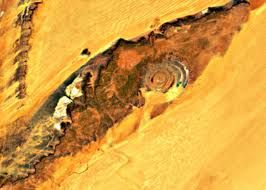
Nestled in the heart of the Sahara Desert, in the nation of Mauritania, lies a geological formation that continues to captivate researchers, travelers, and historians alike. Known as the Eye of Africa (or Richat Structure), this mysterious landmark stands as a natural marvel, striking in its symmetry and vastness. Its concentric rings, reminiscent of a giant eye, have sparked endless debates about its origin, with some even speculating that it holds the key to unlocking the secrets of Atlantis.
What Is the Eye of Africa?
The Eye of Africa is an enormous circular geological feature located about 30 miles (50 kilometers) from the coast of the Atlantic Ocean. Stretching over 30 miles (50 km) in diameter, this formation is a prominent feature in the Saharan desert, with its deep concentric rings of exposed rock that appear almost unnervingly perfect from above.
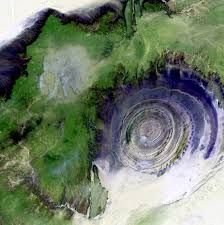
At its core, the Eye consists of layers of sedimentary rock, with the outer rings made up of harder rocks that have resisted erosion, creating the circular pattern. The origin of this formation has been the subject of much speculation and scientific study, but the most widely accepted theory is that it is the result of a dome-shaped uplift of rock layers, followed by erosion over millions of years. This geologic process created the “eye-like” shape, which now stands as one of the most extraordinary natural wonders on the planet.
Historical and Mythical Connections to Atlantis
The Eye of Africa has long intrigued historians, archaeologists, and even those with a more mythical view of history. One of the most tantalizing theories surrounding the Eye is its possible connection to the lost city of Atlantis, the fabled island mentioned by the ancient Greek philosopher Plato.
In his writings, Plato described Atlantis as a powerful and advanced civilization located on a large island, situated beyond the “Pillars of Hercules” (modern-day Strait of Gibraltar). The city, he claimed, was circular in shape and consisted of concentric rings of land and water, with a magnificent palace at its center. After a catastrophic event, Atlantis was said to have sunk beneath the ocean, lost to history forever.
Some scholars have drawn parallels between Plato’s description of Atlantis and the Eye of Africa. The striking similarity between the circular design of the Eye and Plato’s description of Atlantis has led to the suggestion that the Eye could, in fact, be a remnant of the lost city, preserved in the geological record. Although no definitive evidence links the two, the idea has fueled the imaginations of many.
Comparing the Eye of Africa with Plato’s Atlantis
While the theory that the Eye of Africa could be the location of Atlantis remains speculative, it’s fascinating to compare the two. Plato’s Atlantis was said to be a powerful island kingdom with advanced technology and culture. The island’s structure was described as having a central island surrounded by concentric rings of water and land, suggesting a high level of sophistication in its design and construction.
In contrast, the Eye of Africa, although circular in shape, is a natural formation, not a man-made city. However, the idea of concentric rings remains strikingly similar to Plato’s depiction. Additionally, the Eye of Africa lies near the coast, which fits Plato’s description of Atlantis being close to the ocean.
Other Theories: A Meteorite Impact or a Lost Civilization?
In addition to the Atlantis theory, other explanations have been proposed for the formation of the Eye of Africa. One prominent theory suggests that it could have been caused by a meteorite impact. The concentric rings could be the result of the impact creating a large circular structure, similar to the structures found in impact craters around the world. However, there is little evidence to support this theory, as no impact crater-like structures have been found at the site.
Some researchers have even speculated that the Eye could be the remnants of a lost ancient civilization, perhaps predating known history. This idea is largely based on the sheer scale and perfect symmetry of the structure, which seems too precise to be purely natural. However, there is no archaeological evidence to suggest that any civilization ever existed at this site.
The Eye of Africa and Its Mystique
Regardless of its origins, the Eye of Africa remains an awe-inspiring landmark that has attracted geologists, adventurers, and historians for centuries. Its vastness, symmetry, and the mystery that surrounds it make it one of the most extraordinary natural formations on Earth. Whether it’s an ancient impact crater, the remains of a lost civilization, or simply a natural geological formation, the Eye of Africa continues to fascinate and inspire those who encounter it.
A Geological Treasure and a Tourist Attraction
Today, the Eye of Africa is not just a topic of academic interest but also a destination for adventurous travelers. Despite its remote location in the vast expanse of the Sahara Desert, it has become a popular spot for those seeking to explore the wonders of the desert and learn more about the geological history of the region.
However, due to its isolation and harsh climate, visiting the Eye of Africa requires careful planning. Those who venture to this incredible site must navigate the unforgiving desert landscape, often relying on experienced guides to lead them safely through the terrain.
Conclusion: The Unsolved Mystery of the Eye
While the exact origin of the Eye of Africa remains a mystery, its sheer scale and beauty are undeniable. Whether it is a natural geological formation, the remnants of an ancient impact, or even the lost city of Atlantis, the Eye continues to spark curiosity and speculation.
The Eye of Africa is more than just a geological wonder; it is a symbol of humanity’s enduring fascination with the unknown. As we continue to explore and study the mysteries of the Earth, it reminds us that there are still many secrets waiting to be uncovered.
I hope this article captures the essence of the Eye of Africa, comparing it with the mythical Atlantis. Let me know if you’d like to explore other aspects or need more details on
 Metropolitan